Hannah Crissell, Candidate No. 8082
Sam Mealey, Candidate No. 8227

Sunday, 23 May 2010

Friday, 7 May 2010

I-spy

Heres our finished thriller opening:


Just a quick update on how filming went

After our first day of shooting, we found that some of the shots of the computer screen showed lines that weren't there. So we got everything prepared for another session of filming where we concentrated on ensuring there were little, if any lines shown on the screen. To avoid this mistake we had to put the screen at a slight angle which ensure no lines would be shown.

Monday, 3 May 2010

Audience feedback

Questionaire

Me and Sam conducted a questionaire into what people enjoy in the thriller genre and how we can incorperate this into our own thriller. An exampleof one of our questions was: What do you enjoy most about the thriller genre and why?
We got the response from most participants that the suspense of thrillers really creates the interest and draws the audience in, teasing them and giving them narrative engimas so they can try work out the story line but have twists to keep them guessing.


Focus Group

Me and Sam put a focus group together so an audience can watch what we have produced so far and get constructed feedback on ways we can improve on our piece. The suggestions made were the use of a sound track should be included as it is vitual to creating suspense and setting the mood. Enhance the digetic sounds of the current piece to build up tension and draw our audience more into our piece.

Characters, costume, make-up, props and settings

When considering our characters, we wanted to create narrative enigmas surrounding them so we didn't want to give too much away. The opening shows two characters who the audience assume are friends but after reading the messages passed between the two of them, there isn't necessarily any proof of a friendship which creates questions about the relationship the characters share.
The two characters would seem completely normal to the average human being so revealing the characters little by little is a better way of gripping the audience so they never become bored of what they're seeing.
To blend the characters into the stereotypical teenage boy we used people with typically shoulder length, overgrown hair with no make-up and naturalistic costumes. We didn't need to purchase anything for our costumes as (being of the same age as our characters) we had the appropriate clothing to display our characters ages).
In terms of props, we relied on a working laptop and webcam in two different rooms. Although only one of each were shown in our piece the other laptop and webcam were used to enable us to show somebody on webcam, a key part in our opening. We had to create a 'top secret file' to progress the story and relieve one question (what is the file) that cues many more (such as; Why does a secret file concern young teenagers?, Who is the man in the file? and What does it say?). We used a red background for the file to ensure it's bold enough to stand out and put an image of a man in a suit on the front large enough so people can see it and assume the file concerns him.
Of course to include this we needed the printer as a prop to film printing the file. Hannah and I thought of a perhaps subtle, yet effective prop use of a mug. There is a scene where our main character turns around on his chair, gets up and grabs the mug and drinks from it while being followed by a pan from the camera. Including this scene breaks up the piece a little bit and creates a kind of relief for the audience after being confronted with lots of close-ups and extreme close-ups in succession.
The setting we used for the main characters room contains models of boats along with sails, oars and various other parts, suggesting that there could be an obsession with the nautical. If the audience were to take the assumption further they could then link this obsession with the reason he's interested in secret information (for example, when he was a child, his father may have been killed in the navy).

Defining our target audience

To maximize revenue, it is important to have a target audience for your product. This helps developers to control content to gain the appropriate classification certificate for their film. for example if a spy-thriller is aimed at 12-20 year olds it would be inappropriate for them to include content that would cause the film to be classified as an 18 as this would cut out a substantial percentage of their potential consumers, ultimately losing income.
The typical age range for a film is 16-25 as this is proposed as the age range when people have the time and money to watch films at the cinema. We decided to aim for a similar target audience however the introduction of modern technologies along with a teenage protagonist may create an appeal to a younger audience, for example 14-25. Targeting this audience would require a rating of 12/15 to include the highest percentage of possible consumers.

Storyboards

Here are the storyboards, the page numbers didn't show up but they are in order from top to bottom.


Original plans and alternative ideas

During the early stages of we came up with several ideas, these included the use of hospital corridors and office blocks which drew us to conclude that it would be unlikely that we could film the required scenes to really give the dramatic tension we were after. So we talked about simpler ideas and Hannah recorded them in a mind-map.
Here is the result:
We didn't focus solely on one idea, instead we focused on developing both of our main ideas. The result was an opening we were going to call Endurance. So I came up with a story line and drew up some rough ideas on how we could approach the narrative.

A 17 year old girl has been impersonating people online and leading people to make a fool of themselves, she has been doing this for 4 years now. Although recently she has been risking more than just pride to fool people into relationships with these fake people. To make things more 'fun' she decided to involve her closest friends.
However, the fun was cut short when her friend is due to meet her make believe boyfriend in an unfamiliar wooded area. After disappearing for two days her body is found in a nearby river. After months of investigation, the police stumble over records of previous text and instant messaging conversations with a mystery boyfriend. Later leads have the police locating the position of the fake boyfriend as the house of the dead girls best friend.
After several interviews, the 17 year old is accused of the murder of her best friend. With the evidence of their meeting arrangements against her along with her lack of explanation, she has to find a way to prove her innocence.
But there is more to her character, a dark past that could in fact provide a secret innocence to her actions, but before she has the chance to speak out, her regret and lack of dignity along with her new found lifestyle of violent abuse from both those she knew and strangers, grabs her and starts to take control.
At the lowest point of life she takes an overdose of pills, after viewing a collection of articles, as the history repeats itself in her final moments she writes a final statement suggesting she was innocent all along.
The police along with one of the girls friends later find clips of her past and realise not only was she innocent, but her family holds a much darker past explaining her twisted ways.

The opening would of shown the 17 year old girl lying on the bathroom floor with pills and newspaper articles scattered around. As the camera pans up on the body there will be voice overs and flashbacks showing violence from friends and strangers, as well as psychiatric and police opinions. As the camera pans up more, the girls lifeless face is revealed. Here are the designing sketches with some ideas written on them (Click to enlarge):


How does "Memento" use the codes and conventions of the thriller genre


"Memento" uses many of the codes and conventions of the thriller genre such as narrative enigmas which is when the film is making the audience ask questions which may or may not be answered. This is shown in "Memento" as the present is in black and white and the past is in colour. This asks questions because it's hard to work out what is actually going on and creates a confusion between time and space so the audience ask "What's the actually happening now and what happened in the past?" Another way which "Memento uses the codes and conventions is the idea of iconic props, which is a prop typical to the genre of the film. In "Memento" the iconic rop of the thriller genre is the pistols that are used as this represents crime and creates suspense which is often seen in a thriller. Another way is that "Memento" Implies elements of ambiguity which is when something has more then one meaning for example Lennard uses the Polaroid camera photographs as his memory's but the pictures are also used to tell the audience the plot like a jigsaw puzzle as they all fit together towards the end. "Memento" also uses elements of film noir as we are shown the idea of a rugged main character who is slightly mysterious which is Lennard along with shadowy low key lighting and sets to emphasis the blackness of the film. There is also elements of a femme fatal who is Natalie as she starts off being portrayed as good but the audience also question if she is really out to help him or if she is trying to guide him into more danger so we question if she is good or bad and later find out the answer to that. Another convention "Memento" uses is the idea of voyeurism which is the idea that we are watching someone else's personal life passively and that we are intruding as we would not do that in real life. This is shown in "Memento" when Lennard is on the phone, he is having a personal conversation with someone and we are intruding in on his conversation and trying to figure out what he's talking about and who he is talking too. "Memento" uses lots of elements of foreshadowing as it is telling the story in the future and the past at the same time, so when the audience are shown a picture which we haven't seen happen yet it is dropping a hint to the plot we have yet to see and makes the audience keep trying to guess what's going to happen next and work out the ending for themselves. Finally "Memento" uses the conventions of a thriller through its camera work as it shows constant pans and tilts to tease the audience and make them ask questions for what is going on for example in the montage scene there is many pans and tilts so the audience can't work out what is going on.

Thursday, 29 April 2010

Links to Leon

"Leon" (1994) directed by Luc Besson is another thriller that we studied in the process of creating our thriller opening. We decided to use aspects from Leon such as not revealing the main character right at the beginning of the thriller. We thought this was effective as it makes the audience ask questions such as "who is this man?" and "Is he good or bad?". This is a key element of thriller and creates tension and suspense for the audience which draws them more into the film and then they before more emotionally involved so the impact it has on them is bigger. I thought Leon was a good thriller personally and I thought it worked well hiding Leon's features and his identity from us as we did not know if he was good or bad making us as the audience ask more questions about his life style and as him as an individual. Although Leon is more about killing and assassination where as our thriller is about revenge on a past experience's rather then completely focusing on death as a theme.

Flashback Ideas


We had a few ideas for the flashback, the camera was to be positioned at a low level as a Point of View shot (POV) showing a woman in her early twenties crouched in the centre of two legs, crying. The camera would then move backwards and be pulled away from the woman who would reach for the camera and scream then be restrained from activity by the owner of the legs. We thought of using sound effects of a baby crying so that the audience got a clue that the POV is that of an infants.
A good location for this would have been a riverside or in a docks as if the family were enjoying a peaceful day until these events occurred. The contrast of a sunny day to the narrative is something inspired by 'American Psycho' where they use upbeat non-diegetic back ground music despite the horror sub-genre of the film.
The river in Ixworth would be ideal for shooting this scene, the only problem with the location is dog walkers. There is a footpath route through it which could interfere with our filming. Therefore we would need an individual to stand a few metres down the path to quietly explain to passers by that filming is occurring and asking them to be as silent as possible when passing.


A student sample called "Virus"

This is some more information on how we have developed our idea. We saw a small example of a low budget production called virus, this also used the idea of web cams and technology to prioritise their film. We were strongly influenced by this as it showed us how we could use web cams effectively within our thriller. Virus was more of the horror genre then a thriller, we established this because they use super natural references where as a thriller is more realistic with it's content though the genre of virus is debatable and can be described with sub-genres. During this horror a man uses an Internet chat room and web cam to see his wife/girlfriend but it differs from our storyboarded thriller as they use a virus file which opens up the web cam and then the wife/girlfriend gets taken away by a supernatural being. The whole piece is set within a office and used the idea of silence but also using enhanced dietetic sounds to do with technology. We decided to stick to a more realistic approach with our thriller by using humans rather then supernatural beings also with a realistic story line which is exaggerated in some parts for more tension and audience pleasure. This film helped us a lot to define the fine line between horror and thriller and allow our piece shine through as a thriller and not have to be debated over the genre.

Thoughts update

We've just finished redrawing the storyboards (they should be up soon). In terms of cast and locations we thought of using our friend Tom's bedroom which features several posters of various bands and games to give the sense of the main character just being a 'typical' teenager. We'd confirmed the use of my bedroom as the location for the webcam to be used as the camera angles we were able to achieve show the movement from the chair to the door with relative ease.
For the 'everyday scene' we were also considering showing the main character either preparing dinner (chopping ingredients) or watching television and flicking through the numerous channels (possibly giving us a chance to feature a news report featuring several clues to the narrative development).

Basic storyline for our thriller

We had a few mix-ups about the storyline originally but they became settled into this:
We decided to have a man sitting at his desk on his computor, when his friend goes on webcam and tells him hes found the file they've been looking for he becomes a bit anxious. The friend sends the file across and when the file downloads onto his computer the webcam shows his friend being wrestled around by a government official. We were unsure whether to have the main character use print screen and get a still of his friend being taken or have him receive the file, print it and reveal it's contaminants. This would then cause a flashback to his past where a scene is shown of his mother being taken by the government officials. His reaction to this memory will be shown then there will be a short scene of the main character perfoming an everyday activity like cooking or watching television. There will be a cut away and government officials may of been shown entering a front garden and walking up a pathway while constantly cutting inbetween the acitvity and government men at a quickening pace to build tension, then a knock would be heard by the main character and after the reaction was shown the opening would end.
Sound good?
why not give us some feedback and any tips for improvements?

Case Study - Christopher Nolan

Christopher Johnathan James Nolan (pictured above) was born in London on the 30th July 1970. He began making films when he was 7 using his dads super 8mm camera and action figures. He spent a lot of time in Chicago where he made short films with future director and producer Roko Belic . He was educated at an independent school in Halesworth and later studied English literature at University College London where he was also involved in the college film society, filming several short films.

His first was featured in a independent film and video showcase on PBS known as ‘Image Union’. His second piece “Larency” was shown in the 1996 Cambridge Film Festival.

Chris' first feature film was called 'Following' about a write who is obsessed with following random people. The scenes are shown out of chronological order as three acts which are cut together. This style was later developed in the golden globe and oscar nominated Memento (2000). Where the story consisted of two linear timelines, one running backwards and another more previous timeline running forwards, the two narrative timelines meet at the end giving the audience an understanding. Another critically praised film worth mentioning is Insomnia released in 2002 as an American remake of a European film. The non-linear narratives featured in both Memento and Following have become associated as a directorial style of his.

In 1997 Christopher married producer and author Emma Thomas, the same year Warner Bros Pictures put the batman film franchise on hold after the disappointingly negative reviews of 'Batman and Robin'. Christopher took advantage of this when in 2003 he along with David S. Goyer (screenwriter for Blade') convinced Warner Bros. to entrust the reviving of a franchise to a developing director. This trust payed off when the first of the franchise 'Batman Begins' became a box office hit in June 2005.

After releasing his fifth feature film 'The prestige' Batman sequel to be called 'The Dark Knight'. The film broke the record for the highest-grossing opening weekend opening in the US bringing in over $158 million and had overwhelming success.

What makes a thiller a thriller?


Thrillers are determined thrillers generally by including fast pace, frequent action and hero's who over power the villains. Thrillers are also conventional for suspense, cliff hangers and red herrings which keep the audience locked in to the film and on their toes. Thrillers tend to be set in exotic place's such as deserts, polar regions or high seas. The main character/hero is traditionally a male who is in love with danger and has no fear but women have been increasingly becoming popular as the lead role in thrillers for example Sigourney Weaver's character Ripley in "Alien" (1979). The thriller genre normally goes hand in hand with the Mystery genre but in recent years thrillers have been interlinking with horror or psychological-horror and don't always have that happy ending for their main character and tend to make them less of a hero and more flawed so the audience can relate them them as real human beings and therefore be more engaged. So in thrillers influenced by film noir or tragedy the hero is often killed in the process of defeating the villain. The bourne films contain many conventions of thriller starting off with "The Bourne Identity" and carrying on through to the other two films "The Bourne Supremacy" and "The Bourne Ultimatum" directed by Paul Greengrass.The conventions it holds are that of the hero aspect with "Jason Bourne" as the hero and it also contains constant action with fast pace editing so fits nicely in the thriller genre but may also have a sub-genre of an adventure film. A thriller which takes on the more modern sub-genre of psychological horror is "Momento" which is directed by Christopher Nolan which I think personally is an amazing thriller and piece of work. "Momento" uses the fast pace editing through it's montages and flash backs which gives it the conventions of a thriller but it also has a twist on the whole hero aspect as through out most the film we believe he is a hero avenging his wife's death but we find out later that this doesn't turn out to be the case and he is his own villain so it also breaks thriller conventions in that case. Another well known thriller director is Alfred Hitchcock who directed thrillers such as "The Man Who Knew Too Much" (1934), "The 39 Steps" (1935), "Secret Agent" (1936) and of course his very famous "Psycho" (1960).

Textual analysis of the opening 2 minutes of "American Psycho"
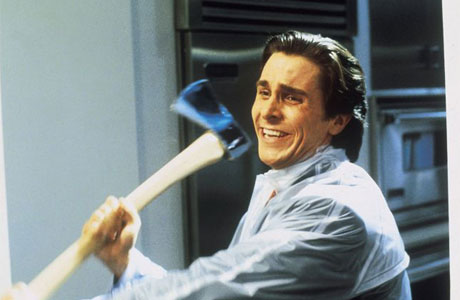


"American Psycho" was directed by Mary Harron in 2000. "American Psycho is a thriller with a horror sub-culture and based on a middle class business man who slowly turns to madness.

In terms of Mise-en-scene the audience are shown many references to murder and blood for example it portrays the splats of raspberry sauce as dripping blood along with the butchering of a piece of cooked meat with a fairly big knife being hacked into it as if it was a stabbing but it is actually all just food being prepared in a fancy restaurant.

In terms of camerawork the audience are shown many extreme close ups of the food being prepared to first hide the fact it's actually food and make the audience question whether it is blood or not. we are then shown a pan across a table of food and around the shape of the round table which is a long shot then leading to a tilt up the menu but through all this all faces are unrevealed until the last few seconds of the two minutes where the main characters are revealed this makes the audience ask questions through out most of the opening but also gives the suggestion that these people are fairly rich and well brought up into a traditional well mannered society.

In terms of sound the audience hear violin strings being plucked as the drops of raspberry sauce hit the plate which connects the music to the image and draw the audience more into the thriller. The sauce is then dribbled over the plate and the music connects to the way in which the raspberry sauce is dribbled over the plate in a swirl. The music is also unconventional for a thriller or a horror as it is upbeat and happy music which may suggest the idea of the main character being a psycho as it is sick to see murders as upbeat and happy.

In terms of editing and lighting there are mainly straight cuts through out the opening 2 minutes and slow editing which is also unconventional of a thriller as they normally show fast pace editing to get the audience on their toes and really thrill them. The lighting tends to be naturalistic but I think it's a bit brighter then natural lighting to suggest to the audience that all the fancy food is just all a bit fake for the main characters life, like an act put on, a mask.

Me and Sam analysed this see if it would inspire our Thriller but we decided to stick to the conventional thriller music and we didn't want to make our piece have a horror sub-genre so we learnt from this that the style of music is really important in creating moods and different styles of thrillers and also makes the audience preserve something in a different way.

Textual analysis of the opening 2 munutes minutes of "Memento"

"Memento" is directed by Christopher Nolan in 2000 and is a mystery Thriller based around the Psychology of memory loss.
In terms of Mise-en-scene we come across a Polaroid picture of a dead body which slowly reserve develops back to white which suggests that the audience is being shown ending at the beginning of the film. We can also link this to our thriller due to the use of technologies such as the Polaroid camera used as the main prop, although we used a more modern form of camera which is the web cam as the main prop.

In terms of camera work there is an extreme close up on a hand and a Polaroid picture of a dead body. This makes the audience ask questions such as "Who is holding the picture?" and "Why are they holding that picture" to create a sense of mystery and draw in the audience. We are also seen a slow tilt upwards when the character "Lennard" is finally revealed and introduced to the audience as a main character by being the first person shown. We use aspects of this in our thriller as our main character has his hand over the web cam and is slowly revealed after he takes it away and makes the audience ask questions such as "Who is he?" and "why is he on web cam?".

In terms of sound right from the beginning we can hear orchestral music which is calming yet sad music using instruments such as violins which sets the theme for the disturbing image of the dead body which we are shown which lets the audience know that something bad has happened for example a tragic murder. We have been considering using some mood setting music for our thriller opening as an improvement and may take on a more modernised piece of music as our technologies are more modern then that of memento.

In terms of Lighting and editing we are shown natural lighting all through the first two minutes of the film which suggests that it is trying to be realistic to the real world so that the audience can relate more to the thriller. In editing when we are shown the hand shaking the picture, which is set outside it then cuts from point of view and graphic matches to Lennard inside shaking the picture in the same way which makes the audience ask questions and suggests that there is confusion over what tense the film is in (past, present or future or maybe a mixture). In our Thriller we decided to use naturalistic lighting to create realism so the audience can connect more to our thriller.


Please note that we only used up to 1 minute 20 of this youtube video

Textual Analysis of the opening 2 minutes of 'The Invasion'


'The Invasion' is a sci-fi thriller directed by Oliver Hirschbiegel, released 12th October 2007 starring Nicole Kidman and Daniel Craig, about a washington psychiatrist who unearths the origin of an alien epidemic.

The mise-en-scene in the opening scene starts with a black title screen shown with an animated Warner Bros. logo which flies past the camera. The way the logo glides past is almost as if it is a UFO which refers to the conventions of aliens featuring in a sci-fi film. The audience is then confronted with a flickering shop light and pharmaceutical products sprawled over shelves and scattered over the floor, this allows the audience to assume that the setting is a abandoned pharmacy. The fact that pharmacies are associated with helping people yet this one has clearly been devastated is a cause for questioning from the audience.
As a rapid montage of shots pass a woman charges through a door and indirectly approaches the camera, she has straggly blond hair and pale skin with naturalistic dark make-up around her eyes. From this we assume she has had little sleep suggesting that there's something preventing her from falling asleep. The woman desperately scrambles around the pharmacy looking at all of the different types of medication and starts pouring a concoction of them into her hands, suggesting it is in fact her keeping herself from falling asleep.

Sound plays an important role in establishing the mood, while the Warner Bros. logo flies past there are faint helicopter propeller sounds then some slightly unexplained hovering sounds to further suggest the symbolism of the WB logo as some sort of flight craft. There is also a deeply humming, eerie background music playing to keep the audience on edge as they wait to find what's to be shown to them.
As the pharmacy is introduced there is a faint breathing which increases in volume to reveal itself as exhausted pants and sobs of an exhausted woman. These sobs turn into rapid voices whispering things like "I've got to stay awake", "please stay awake" and "you can do it, come on" portraying the need to prevent sleep. There are then diegetic off-screen pleas from unknown sources behind a door asking to be let in. All of this plays a key role in defining the desperation of the characters within the situation.

In terms of camerawork the director really seems to force the panic onto the audience. To achieve this there is a focused use of handheld POV shots to put the audience in the woman's place so they can see what she sees. There is also a blur and pulse effect to distort the view to help the audience see exactly how she sees things with her exhaustion. To emphasise the need for medication there are extreme close-ups of different labels leading to close-ups of her pouring the pills into her hands. Another use of camerawork is to suggest those begging to be let in are employees from the staff room as there is a close-up displaying an "employees only" sign.

The speed of the scene is something that really grips the audience, and editing is the way this speed has been created. Straight cuts are featured throughout the entire scene and the rapid pace of the cuts passes a number of images as if a passing blur. This pace forces concentration from the audience if they want the various questions they have answered.

One thing we liked about this opening was the way questions flooded into our heads, we wanted our opening to have a similar effect and decided to give away as little as possible while still gripping our audience.

Preliminary task video

Preliminary task

As a warm up to practice our skills for the main task, we were asked to create a preliminary exercise. Focusing on continuity, this task had to involve filming and editing a character opening a door, crossing a room and sitting down in a chair opposite another character, with whom they then exchange a couple of lines of dialogue. The task had to demonstrate match on action, shot/reverse shot and the 180-degree rule.
We ended up creating two pieces when approaching this task, the first broke the 180-degree rule, breaching one of the rules of the task. This encouraged us to set out again to film our second piece which adheres to the requirements. The result will be posted shortly by Hannah.

Welcome to our thriller production

Me and my work partner Sam have decided to resubmit our Thriller work as we believe we could improve on our work so for this we have created a new blog so we can put our work in a good order and improve on the work we have already created to hopefully boost up our grades. So in this blog we will be including; our storyboards, detailed textual analysis on related thrillers, alterations made to our final piece, audience feedback and the process in which our final product has come to be. We will also include our preliminary task and evaluation progress and products onto this blog.